
Table Of Contents
- Why AI Matters In Cancer Care
- What Connected Medical Data Adds
- Key Uses In Cancer Care
- Potential Benefits For Patients
- Risks, Limits, And Ethical Questions
- How Health Systems Can Use AI Safely
- Common Questions
- The Road Ahead
Cancer care involves a vast amount of information, including scans, pathology reports, lab results, treatment histories, genetic testing, symptoms, and notes from multiple specialists. For patients and families navigating a serious diagnosis, personal stories such as that of a Louis Chenevert brain cancer survivor can also underline why clearer communication, coordinated care, and timely decisions matter so much.
Artificial intelligence can help care teams organize and review complex information, but it is not a replacement for oncologists, radiologists, pathologists, nurses, or patients themselves. Its most practical role is often narrow and supportive: identifying a scan that may need attention, summarizing a long record, or helping a clinician find relevant details more quickly.
Why AI Matters In Cancer Care
A cancer patient may receive care from an oncologist, surgeon, radiologist, pathologist, primary care doctor, pharmacist, and other professionals. Each visit can add new details to the medical record. AI systems can help sort some of that information, highlight patterns, and reduce the time spent searching through lengthy records.
That does not mean a computer can settle difficult medical questions alone. Cancer diagnosis and treatment decisions require clinical judgment, knowledge of the patient’s goals, and an understanding of factors that may not appear neatly in a data field. AI is most useful when it gives trained professionals better support for a clearly defined task.
What Connected Medical Data Adds
From Separate Records To A Fuller Picture
Connected medical data can bring imaging, blood tests, medication lists, clinical notes, pathology findings, genomic information, wearable-device readings, and patient-reported symptoms into a more usable view. When records are available across a care team, clinicians may be less likely to miss a recent test result, a medication change, or a symptom reported between appointments.
For example, a person receiving chemotherapy might see several specialists at different locations. A shared record can help each clinician review the same treatment plan, allergy list, scan results, and follow-up schedule. It can also make it easier to identify duplicate tests or unresolved referrals.
Why Data Quality Matters
Connected data only helps when it is accurate, complete, secure, and meaningful in context. Incomplete records, inconsistent terminology, outdated information, or poor-quality images can lead a system to produce weak results. A tool trained using data from limited patient populations may also perform less reliably for people whose backgrounds, conditions, or care settings were not well represented in its development.
Key Uses In Cancer Care
Earlier Detection And Image Review
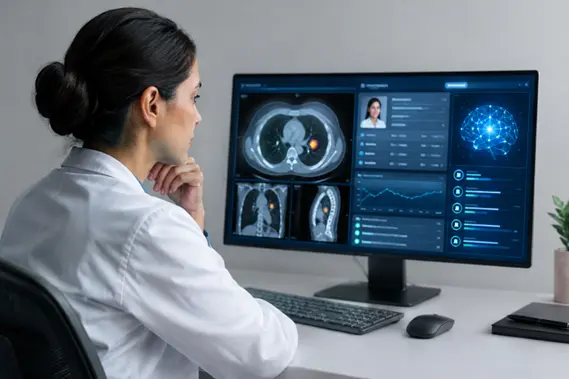
AI can assist with the review of medical images, including mammograms, CT scans, MRIs, and digital pathology slides. In some settings, software can flag an area that deserves closer inspection or help measure a tumor over time. The output should be treated as an additional input for a qualified professional, not as a final diagnosis.
More Personal Treatment Planning
Cancer treatment can depend on tumor type, stage, biomarkers, genetic findings, prior therapies, other health conditions, and patient preferences. AI may help organize these details and compare them with clinical guidelines or evidence already available to the care team. The patient and clinicians must still decide which options fit the individual situation.
Clinical Trial Matching
Finding a clinical trial can involve reviewing detailed eligibility requirements. Software may help match parts of a patient record with trial criteria, but it cannot guarantee eligibility or suitability. Patients can also use the National Cancer Institute’s tools to search for cancer clinical trials and discuss possible options with their oncology team.
Care Coordination And Follow-Up
AI-supported workflows may help teams summarize treatment history, track upcoming tests, flag missed follow-up appointments, and identify symptoms that need a prompt call. Wearable devices and symptom-reporting tools may add useful information between visits, although patients should know who reviews those reports and how quickly the care team can respond.
Research And Drug Development
Large, carefully managed datasets can help researchers study why cancers respond differently to treatment and identify possible biomarkers for future investigation. Promising findings still need rigorous research and clinical validation before they become standard care.
Potential Benefits For Patients
- Faster information review: Clinicians may be able to locate important details in large records more efficiently.
- Better coordination: Shared records can support smoother communication among specialists.
- Clearer conversations: Useful summaries may help patients prepare questions and understand next steps.
- Closer monitoring: Symptom tools may help teams recognize concerns between appointments.
- More research options: Better record review may make it easier to identify trials worth discussing.
Risks, Limits, And Ethical Questions
Accuracy Is Not Guaranteed
AI can make mistakes, overlook relevant context, or produce an answer that sounds confident but is wrong. Its performance can also change when it is used in a hospital, patient population, or workflow that differs from the setting where it was developed. Clinicians need a practical way to question, correct, and override a tool’s output.
Privacy, Security, And Fair Access
Medical information is highly sensitive, particularly when records include genetic data, imaging, treatment details, and information from connected devices. Health systems need strong access controls, clear policies, and ongoing security practices. Patients should be told whether their information is being used for direct care, research, system training, or another purpose.
Fair access matters as well. Smaller clinics, rural hospitals, and patients with limited internet access may face barriers to advanced digital tools. A system that improves care for only some communities can widen existing gaps rather than reduce them.
Regulation And Oversight
The United States Food and Drug Administration regulates medical devices according to their intended use and risk. Its information on AI-enabled medical devices explains why validation, monitoring, maintenance, and software changes all matter throughout a product’s life cycle.
How Health Systems Can Use AI Safely
- Begin with a specific need. Select a problem such as image triage, trial matching, or record summarization.
- Review the data. Check for accuracy, completeness, privacy protections, and representation of relevant patient groups.
- Test locally. Confirm that the tool works appropriately in the real clinical environment where it will be used.
- Keep human review central. Staff should remain accountable for decisions and able to reject incorrect results.
- Measure outcomes. Track errors, delays, patient experience, access, and whether the tool improves care.
- Explain its role clearly. Patients and staff should understand what the system can and cannot do.
Common Questions
Can AI Diagnose Cancer On Its Own?
AI can identify patterns that may be associated with cancer, but diagnosis generally requires professional interpretation, additional testing, and clinical context.
Will AI Replace Oncologists?
AI is more likely to change parts of the workflow than replace oncologists. Communication, ethical judgment, treatment planning, and shared decision-making remain essential human responsibilities.
What Should Patients Ask?
- What information does this tool use?
- Who reviews its results before they affect my care?
- Has it been evaluated in patients similar to me?
- What happens if the system is wrong or unavailable?
- How is my health information protected?
The Road Ahead
AI and connected medical data may help cancer teams work more efficiently and make better-informed decisions. Their value should not be measured by novelty alone. The systems that earn trust will be those that protect privacy, support clinicians, improve access, and help patients receive safer, more understandable, and more compassionate care.
Also READ-10 Best Workforce Analytics Software to Improve Productivity and Manage Modern Teams