
Almost every student has been told they are a visual learner, an auditory learner or a kinesthetic one.
The research does not support it. Repeated studies have failed to find that matching teaching to somebody’s preferred style improves what they actually learn, and the idea has persisted mainly because it feels true and because people enjoy being told something about themselves.
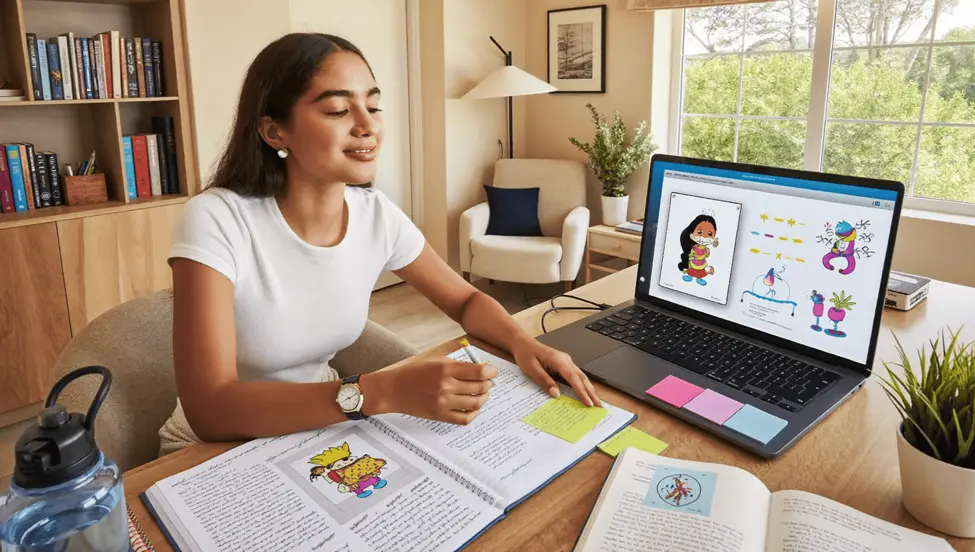
What the evidence does support is less flattering and considerably more useful: combining words and images helps almost everybody, regardless of what style anybody thinks they prefer.
That distinction matters because it changes what you make. Not materials tailored to your type, but materials that pair an explanation with a picture, which is a thing worth doing whoever you are.
An AI Cartoon Generator from Higgsfield, an AI creative suite, makes producing those quickly realistic, and there are two things it must not be trusted with.
Why Does Pairing Words and Images Work?
Because the two are processed through different channels and reinforce each other.
Information that arrives as text alone has one route into memory. The same information with a diagram attached has two, and recall from one can trigger the other.
Where the effect is strongest:
- Processes and sequences, where order matters
- Structural content, including anatomy, geography and chemistry
- Abstract concepts that need something concrete to hold onto
- Cause and effect chains, which diagram naturally
- An AI Cartoon Generator illustration you made rather than downloaded
That last point is not decoration. Producing material yourself improves retention more than consuming somebody else’s, which is why making your own diagram beats finding a better one online.
The better diagram helps less than the worse one you drew yourself, which is counterintuitive and well established.
Does Decorative Imagery Help?
No, and it actively hurts, which surprises people.
Research on what is sometimes called the seductive details effect consistently finds that interesting but irrelevant images reduce comprehension rather than improving it. The attention goes to the picture and not to the point.
What that rules out:
- Images added to make notes look nicer
- Anything amusing that does not illustrate the concept
- Backgrounds and borders, which compete
- Multiple images per concept, which splits attention
- An AI Cartoon Generator picture chosen because it looks good
The practical rule is that every image should be answerable. If somebody asked what this picture is teaching, there has to be a specific answer.
Pretty notes are a well-known form of procrastination. Two hours making something beautiful feels like work, looks like work and teaches very little.
What Must Never Be Trusted Without Checking?
Anything factual, which is most of what a student needs.
- Never trust an anatomical diagram without checking it against a source
- Never trust a chemical structure, which models get subtly wrong
- Never trust a labeled map, since place names fail badly
- Never trust a mathematical figure produced rather than drawn
- Never revise from an AI Cartoon Generator image you have not verified
The failure mode here is specific and dangerous. A generated anatomical diagram is not obviously wrong, it is plausibly wrong, with a structure in the wrong place or a vessel that does not exist.
A student revising from it learns something false and learns it well, because the diagram did its job and made it memorable.
Check every factual image against the textbook before using it. The checking takes a minute and the alternative is being confidently wrong in an exam, which is the worst way to be wrong.
Where Is It Safe and Useful?
Concepts, metaphors and structures you supply yourself.
- Illustrating an analogy you were given in class
- Visualizing an abstract idea, where accuracy is conceptual rather than factual
- Character or scene imagery for languages and literature
- Memorable images for mnemonics, which is a genuine technique
- An AI Cartoon Generator picture where you provide the content and it provides the drawing
The mnemonic case is the strongest. Memory techniques that rely on vivid, strange imagery work considerably better when the image actually exists, and generating a specific odd picture is faster than drawing one.
For languages, an image attached to a word avoids translating through your first language every time, which is how fluency actually builds rather than how vocabulary lists build.
You supply the concept and the tool draws it. That division is what keeps the facts yours rather than borrowed.
Should You Label Diagrams Yourself?
Always, and this is where most of the learning happens.
A labeled diagram handed to you is a reference. A blank diagram you label from memory is a test, and testing yourself is the single best-evidenced revision technique there is.
- Generate the structure unlabeled
- Label it from memory, then check
- Note what you missed, which is your revision list
- Repeat it days later, not minutes later
- Keep a labeled Higgsfield master for checking against
The spacing matters as much as the testing. Re-labeling the same diagram ten minutes later proves nothing, and doing it three days later proves a great deal.
What you get wrong is the useful output. A session where you label everything correctly taught you nothing you did not already know, however good it felt.
Is This Better Than Highlighting?
Considerably, and highlighting barely works at all.
Studies ranking revision techniques consistently place highlighting and re-reading near the bottom. Both feel productive and both mostly produce familiarity, which the brain mistakes for knowledge.
What ranks higher:
- Retrieval practice, meaning testing yourself
- Spaced repetition, spreading sessions out
- Elaboration, explaining why something is true
- Interleaving, mixing topics rather than blocking them
- Dual coding, which is where an AI Cartoon Generator fits
The familiarity trap is worth understanding properly. Reading a page five times makes it feel known, and being asked to reproduce it from memory reveals that it is not. Testing feels considerably worse and works considerably better, which is why so few people do it.
Make something you can be tested on rather than something you can look at, and keep the Higgsfield originals purely for checking afterwards.
How Should Flashcards Use Images?
Sparingly, with the image doing specific work.
- One concept per card in the Higgsfield set, always
- Image on one side, prompt on the other
- Use images where words are slow, such as structures or processes
- Avoid images on definition cards, where they add nothing
- Keep an AI Cartoon Generator style consistent, so nothing distracts
Consistency matters because novelty is a distraction. Cards that each look different draw attention to the design rather than the content.
Digital, Higgsfield or paper all work. The evidence favors whichever you will actually use daily, and daily is the variable that matters more than the format.
Resources like the education section here are worth reading alongside, since technique matters more than tools and is the part nobody enjoys researching.
What About Group Study?
Illustration helps most where explaining is involved.
- Draw the concept while explaining it to somebody else
- Have them label it afterwards, which tests them
- Compare AI Cartoon Generator diagrams, since differences expose misunderstandings
- Produce AI Cartoon Generator versions of competing explanations
- Teach it, which is the strongest form of elaboration
Explaining to somebody else is among the most effective techniques in the literature, and it works precisely because you discover the gaps while talking rather than afterwards.
Comparing diagrams is the underused version. Two students who understood the same lecture differently produce visibly different pictures, and the conversation about why is the learning.
Does This Apply to Essay Subjects?
It does, differently, and students in those subjects frequently assume it does not.
- AI Cartoon Generator timelines for history and literature chronology
- Relationship maps for characters, factions or thinkers
- Argument structures, showing claims and objections
- Comparison grids, which are visual even without pictures
- An AI Cartoon Generator scene for a text you are studying
The argument structure case is the valuable one for essay subjects. Laying out a position, the objections to it and the responses as a diagram reveals whether you actually understand the debate or have only memorized positions.
If you cannot draw the argument, you cannot write it, and discovering that at the planning stage is considerably better than discovering it in an exam hall.
Does This Work for Exam Conditions?
It does, and the transfer is the part students neglect.
A diagram you can reproduce at your desk with the textbook nearby is not the same as one you can reproduce in a hall with a clock running.
What makes the transfer work:
- Practice drawing from blank paper, not from a template
- Time yourself, since exam diagrams have to be fast
- Simplify to what earns marks, rather than what looks complete
- Know which diagrams the paper actually asks for, from past papers
- Use the AI Cartoon Generator version for checking, never as the thing to copy
The simplification point is where marks are lost and gained. Examiners award specific labeled features, and a beautiful drawing missing two of them scores below a rough one that includes all six.
Past papers tell you which diagrams recur. Most subjects have a small set that appear repeatedly across years, and those are the ones worth being able to produce in ninety seconds under pressure.
Practice on paper. A diagram you have only ever made on a screen is a diagram you have never actually drawn.
What About Academic Integrity?
Know the rules before anything goes into submitted work.
- Revision materials are yours, and nobody is assessing them
- Submitted work is different, with institutional rules that vary
- Declare tool use where your institution requires it
- Never submit a generated diagram as your own drawing without checking the rules
- Never use an AI Cartoon Generator image in work claiming original research
The distinction is between studying and being assessed. What you make to learn with is private, and what you hand in is governed by rules that differ between institutions and sometimes between departments.
Ask your department rather than assume. Policies have changed repeatedly across the last few years and a rule from last year may no longer hold.
The penalties for getting this wrong are serious and entirely avoidable by reading one page.
What Would One Session Produce?
A topic covered properly in ninety minutes.
- Pick one topic, not a subject
- Identify the processes and structures within it
- Produce diagrams in an AI Cartoon Generator, unlabeled
- Check every factual one against your textbook
- Label them from memory and note the gaps
- Save the Higgsfield set for spaced repetition later
- Repeat the labeling three days on
Then do the same topic again the following week without looking at anything first, and see what survived.
The checking step is the one that cannot be skipped. Everything else is technique, and that one is whether what you learned is true.
FAQ’s
Does being a visual learner matter?
Probably not in the way the phrase suggests. The evidence does not support matching teaching to learning styles, but pairing words with images helps nearly everyone.
Do decorative images help notes?
They hurt. Irrelevant imagery reduces comprehension, and pretty notes are a recognized form of procrastination.
Can an AI Cartoon Generator draw an anatomy diagram?
It can draw something plausible and possibly wrong. Check every factual image against a source before revising from it.
Is this better than highlighting?
Considerably. Highlighting and re-reading rank near the bottom of revision techniques because they produce familiarity rather than recall.
Should diagrams be labeled or blank?
Generate them blank and label from memory. The labeling is the test, and the test is where the learning happens.
Conclusion
The useful version of visual revision has nothing to do with being a visual learner and everything to do with making something you can be tested on.
An AI Cartoon Generator draws the picture while you supply the concept, which keeps the understanding yours, and Higgsfield runs it in a browser on a student laptop.
Generate it blank, check every fact, label it from memory, and come back three days later. The bit you got wrong is the only part that was worth the session.
Also Read
- responses-when-someone-says-you-owe-me/
- what-does-a-guy-mean-when-he-says-you-look-so-innocen/
- funny-ways-to-respond-when-a-girl-says-shes-seeing-someone/