
Many people worry that calling a locksmith for a lockout automatically means drilling the lock or replacing the entire mechanism. In many situations, that is not the case. The condition and type of lock, the reason for the lockout, and the door itself all influence whether access can be restored without permanent damage.
Can a Locksmith Open a Door Without Damaging the Lock?
Imagine arriving home late in the evening and discovering that your keys are nowhere to be found. You call a locksmith, but another concern immediately comes to mind: will the door or lock have to be destroyed to get you inside?
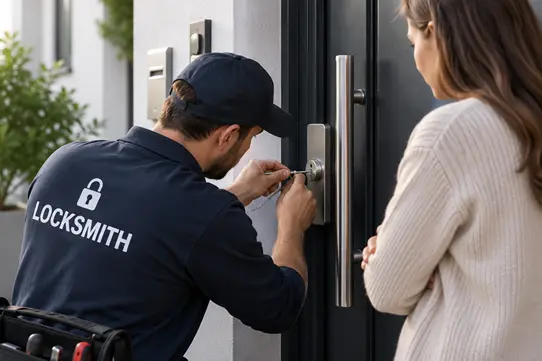
For many ordinary residential lockouts, destructive entry is not automatically necessary. A professional locksmith will typically assess the situation before deciding how to proceed. In suitable circumstances, access may be restored while leaving the existing door and locking hardware usable.
However, no responsible professional can promise damage-free entry in every situation. Several factors determine what is possible.
It Depends on Why the Door Will Not Open
Being “locked out” can describe several very different problems.
You might simply have left a working key inside the house. Alternatively, your key may have been lost or stolen. In other cases, you may have the correct key, but the lock refuses to operate because something inside the mechanism has failed.
These situations do not necessarily require the same solution.
A functioning lock on a normally secured door presents a different challenge from a cylinder containing a broken key or a multipoint mechanism that has failed while the door is closed. This is why an initial diagnosis matters.
The Type of Lock Makes a Difference
Residential properties use many kinds of locks, from conventional cylinders and deadbolts to multipoint mechanisms and electronic systems. Their construction and security features vary considerably.
The door itself matters too. A locksmith working with a timber entrance may face a different situation from one involving a composite, metal, or uPVC door.
Modern security hardware is specifically designed to resist unauthorized manipulation. As a result, the appropriate solution depends heavily on what is actually installed.
Rather than assuming that every lockout can be handled in exactly the same way, a locksmith should identify the hardware and evaluate the available options.
Why Drilling Should Not Always Be the First Option
Customers sometimes assume that a locksmith will immediately arrive with a drill, destroy the cylinder, and sell them a replacement. That should not be considered an automatic outcome for every lockout.
Where appropriate, a professional may first consider methods that preserve the existing hardware. Whether those methods are suitable depends on the particular lock and circumstances.
Destructive entry becomes more relevant when non-destructive options are unsuitable, the mechanism has failed internally, the lock is damaged, or security features prevent another practical approach.
If drilling or replacement is recommended, it is reasonable to ask the locksmith why it is necessary and what will need to be replaced afterward.
A Faulty Lock Changes the Situation
There is an important difference between being locked out because your keys are unavailable and being locked out because the lock itself is broken.
Suppose you insert the correct key, but it spins without operating the mechanism. Perhaps the handle moves but the door remains secured, or a multipoint system no longer retracts correctly.
In these situations, preserving every existing component may not be realistic or even desirable. If a part has already failed, replacement could be necessary regardless of how access is gained.
The goal then becomes limiting unnecessary damage while restoring the door to reliable working condition.
What About a Broken Key?
A key snapping inside the lock is another common problem. When this happens, avoid pushing the remaining fragment deeper into the keyway.
The condition of the lock and the position of the broken piece will determine what can be done. Sometimes the key fragment can be addressed while preserving the cylinder. In other cases, additional damage or an underlying lock fault may make replacement more appropriate.
If your key has become bent, cracked, or increasingly difficult to turn, replacing it before it breaks can prevent this situation.
The Door Can Be Part of the Problem
A lock that appears faulty may actually be reacting to pressure caused by the door.
Doors can move slightly over time. Hinges wear, frames shift, and changes in temperature or humidity can affect certain materials. When alignment changes, the locking points may no longer meet the frame correctly.
This can make a perfectly functional lock difficult to operate.
A good assessment therefore looks beyond the cylinder. Fixing the alignment may be necessary to prevent the same problem from returning after the immediate lockout has been resolved.
Ask About the Approach Before Work Begins
When possible, discuss the likely process and cost before authorizing work. Ask whether the locksmith expects the existing lock to remain usable and what circumstances could make replacement necessary.
Pricing is also worth clarifying. Request information about call-out charges, labour, replacement components, and any additional fees that may apply outside normal working hours.
An exact price may not always be possible before the lock is inspected, but the pricing structure should be explained clearly.
Identification Is a Positive Sign
Do not be surprised if a locksmith asks you to demonstrate that you are entitled to enter the property. After all, the service involves gaining access to a secured building.
The appropriate verification can depend on the situation, especially if your identification happens to be locked inside with your keys. A legitimate professional should still take reasonable steps to establish that the request is genuine.
This protects homeowners as well as locksmiths.
Prevention Can Be Easier Than Another Lockout
After access has been restored, consider why the incident occurred.
If you simply forgot your keys, a securely managed spare may solve the problem in the future. If the lock was becoming increasingly difficult to operate, maintenance or replacement may be more important. If keys were stolen, changing who can access the property becomes the priority.
A lockout can therefore reveal a weakness in either the hardware or your everyday key-management routine.
The Bottom Line
So, can a Locksmith in Lokeren open a door without damaging the lock? In many situations, preserving the existing hardware may be possible, but it cannot be guaranteed for every door and every lockout.
The type of lock, its condition, the door configuration, and the reason access has been lost all influence the solution. A professional locksmith should assess those factors before choosing an approach and explain when replacement is genuinely necessary.
For the homeowner, the best outcome is not simply getting the door open. It is restoring access while leaving the entrance secure, reliable, and ready for normal use afterward.
Also Read